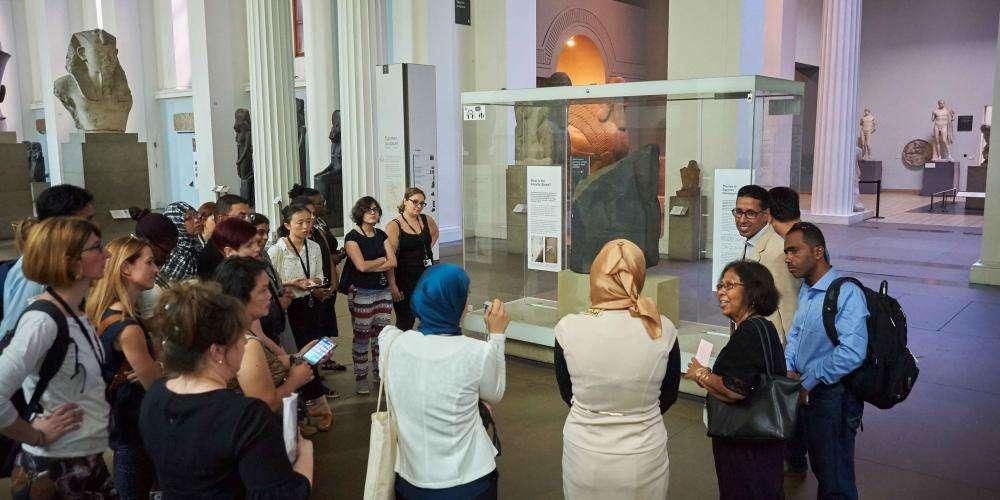
Tours and talks
We welcome groups of any size to the Museum.
- If you plan to attend as a self-led group of 10 people or more, please book with us at least seven days in advance.
- Once you enter the Museum you’re free to stay, within the stated opening hours.
- Please view the Visit page in advance to check if any galleries you plan to visit are closed.
- Tour groups are not permitted in Rooms 33, 33a, 33b, 61, 62, 63 and 91a or any exhibitions.
- If you’re from a UK school and are bringing primary or secondary students, take a look at the dedicated page for school groups.
- If you’re a travel company booking a group visit, you may be able to offer an exclusive out-of-hours tour. See our Travel trade tours section for details.
- Please make sure you’re mindful of other visitors in the Museum. Don’t block exits or entrances.
Getting here for groups
If you’re in a group of 10 or more, you must use the Montague Place entrance, which has a dedicated reception and entry with coach parking nearby and level access. You can get directions to this entrance by using the postcode WC1E 7JW.
Groups will still need to pass through the usual security checks when entering the Museum. Please see the Visit page for details2
Coach parties are advised to use the metered parking on Montague Place, less than a 30-second walk from the Museum. We kindly ask coach drivers to turn their engines off when parked.
See the list of available galleries for you to enjoy
Lower floor
- Room 25: Africa (The Sainsbury Galleries)
Ground floor
- Great Court
- Room 1: Enlightenment
- Room 2: Collecting the world
- Room 2a: The Waddesdon Bequest (funded by The Rothschild Foundation)
- Room 4: Egyptian sculpture
- Room 6: Assyrian sculpture and Balawat Gates*
- Rooms 7–8: Assyria: Nimrud*
- Room 9: Assyria: Nineveh*
- Room 10: Assyria: Lion hunts, Siege of Lachish and Khorsabad*
- Room 12: Greece: Minoans and Mycenaeans (The Arthur I Fleischman Gallery)
- Room 13: Greece 1050–520 BC
- Room 14: Greek vases
- Room 15: Greece: Athens and Lycia
- Room 16: Greece: Bassai sculptures
- Room 17: Nereid Monument
- Room 18: Greece: Parthenon
- Room 19: Greece: Athens
- Room 20: Greeks and Lycians, 400–325 BC
- Room 21: Mausoleum of Halikarnassos
- Room 22: The world of Alexander
- Room 23: Greek and Roman sculpture
- Room 24: Living and Dying (The Wellcome Trust Gallery)
- Room 26: North America
- Room 27: Mexico
Upper floors
- Room 33: China and South Asia (Sir Joseph Hotung Gallery)
- Room 33a: India: Amaravati (The Asahi Shimbun Gallery)
- Room 33b: Chinese jade (The Selwyn and Ellie Alleyne Gallery)
- Rooms 38–39: Clocks and watches (The Sir Harry and Lady Djanogly Gallery)
- Room 40: Medieval Europe, 1050–1500 (The Sir Paul and Lady Ruddock Gallery)
- Room 41: Sutton Hoo and Europe, AD 300–1100 (The Sir Paul and Lady Ruddock Gallery)
- Rooms 42–43: The Islamic world (The Albukhary Foundation Gallery)(Opens in new window)
- Room 46: Europe 1400–1800
- Room 47: Europe 1800–1900
- Room 48: Europe 1900 to the present
- Room 49: Roman Britain (The Weston Gallery)
- Room 50: Britain and Europe 800 BC–AD43
- Room 51: Europe and Middle East, 10,000–800 BC (The Sheikh Zayed Bin Sultan Al Nahyan Gallery)
- Room 52: Ancient Iran (The Rahim Irvani Gallery)
- Room 53: Ancient South Arabia
- Room 54: Anatolia and Urartu, 7000–300 BC
- Room 55: Mesopotamia, 1500–539 BC
- Room 56: Mesopotamia, 6000–1500 BC
- Rooms 57–59: Ancient Levant
- Room 61: Egyptian life and death: the tomb-chapel of Nebamun (The Michael Cohen Gallery)
- Rooms 62–63: Egyptian death and afterlife: mummies (The Roxie Walker Galleries)
- Room 64: Early Egypt
- Room 65: Sudan, Egypt and Nubia
- Room 66: Ethiopia and Coptic Egypt
- Room 67: Korea (The Korea Foundation Gallery)
- Room 68: Money
- Room 69: Greek and Roman life
- Room 70: Roman Empire (The Wolfson Gallery)
- Room 71: Etruscan world
- Room 72: Ancient Cyprus (The A.G. Leventis Gallery)
- Room 73: Greeks in Italy
- Rooms 90–90a: Prints and drawings displays
- Rooms 92–94: Japan (The Mitsubishi Corporation Japanese Galleries)
- Room 95: Chinese Ceramics – Sir Percival David Collection (The Sir Joseph Hotung Centre for Ceramic Studies)
*Limited opening: Rooms 7, 9, 10, 19, 20, 57 and 58 are open 11.00–15.00 daily.
Private guided tours for groups
You can book a number of private guided tours for groups or individuals, allowing you to see and learn about the highlights of the Museum’s collection – see below for details.
These tours are for adult audiences and are delivered in English.